Overview
The challenge provided second.dmp. The file command reported an ELF core file holding VirtualBox-related data, so I treated it as a memory/core dump and analysed it with Volatility.
Finding the suspicious process
After about five hours in the dump, my strongest lead was FL64.exe — FL Studio. It was the most unusual user application in the process list, so I focused there.
vol -f second.dmp windows.pslistThe command line showed FL Studio launching a child msedgewebview2.exe from an Image-Line Edge/EBWebView directory. WebView2 was relevant in context, but its presence alone proved nothing.
vol -f second.dmp windows.cmdlineCarving the plugin
I ran a file scan over the dump and grepped it for anything FL Studio related.
vol -f second.dmp windows.filescan > scan.txt
strings scan.txt | grep -Ei 'fl studio|image-line|plugin|clap|fst|flp|dll|vst|vst3|preset|project'
The useful entries were Arranger.clap and Arranger.fst. The CLAP file was the more interesting of the two: it is executable plugin code that FL Studio loads, which made it worth dumping and inspecting — not proof of anything on its own. The extracted file turned out to be a PE32+ Windows DLL for x86-64, which is normal for a CLAP plugin on Windows.
Reversing in Ghidra
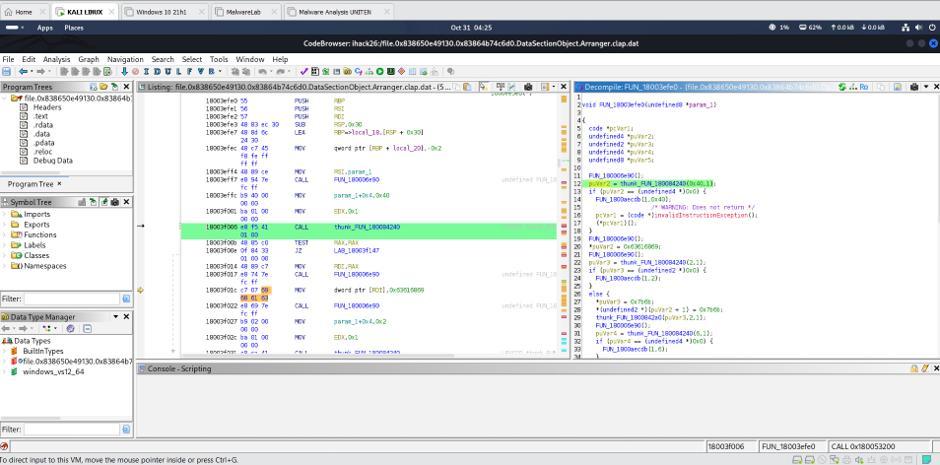
Searching for ihack only returned a short CLAP error string, not the flag. Comparing the functions around the plugin data, FUN_18003efe0 stood out: it allocated a 64-byte buffer, wrote several fixed hexadecimal values into it, and returned it through param_1[1]. That was unlike the cleanup and Windows error-handling code elsewhere in the binary.
Rebuilding the flag
I reproduced the buffer the function builds, writing each hex chunk at its offset.
buf = bytearray(0x40)

def w(off, data):
    buf[off:off + len(data)] = data

w(0,  bytes.fromhex('69686163'))
w(4,  bytes.fromhex('6b7b'))
w(6,  bytes.fromhex('77683474'))
w(10, bytes.fromhex('5f64'))
w(12, bytes.fromhex('305f315f6b6e3077'))
w(20, bytes.fromhex('5f34623075745f74'))
w(28, bytes.fromhex('6831735f7730726c'))
w(36, bytes.fromhex('645f6f665f'))
w(41, bytes.fromhex('6473707d'))
print(buf.rstrip(b'\x00').decode('latin1'))
ihack{wh4t_d0_1_kn0w_4b0ut_th1s_w0rld_of_dsp}
Takeaways
A memory dump is enough to carve an on-disk artifact (windows.filescan plus a targeted dump) without ever touching the original VM. The flag was never a plain string — it was assembled at runtime from fixed bytes, so string searches failed and only reading the construction routine recovered it. For a defender, an audio plugin spawning a browser runtime and building obfuscated buffers is exactly the kind of anomaly worth alerting on.